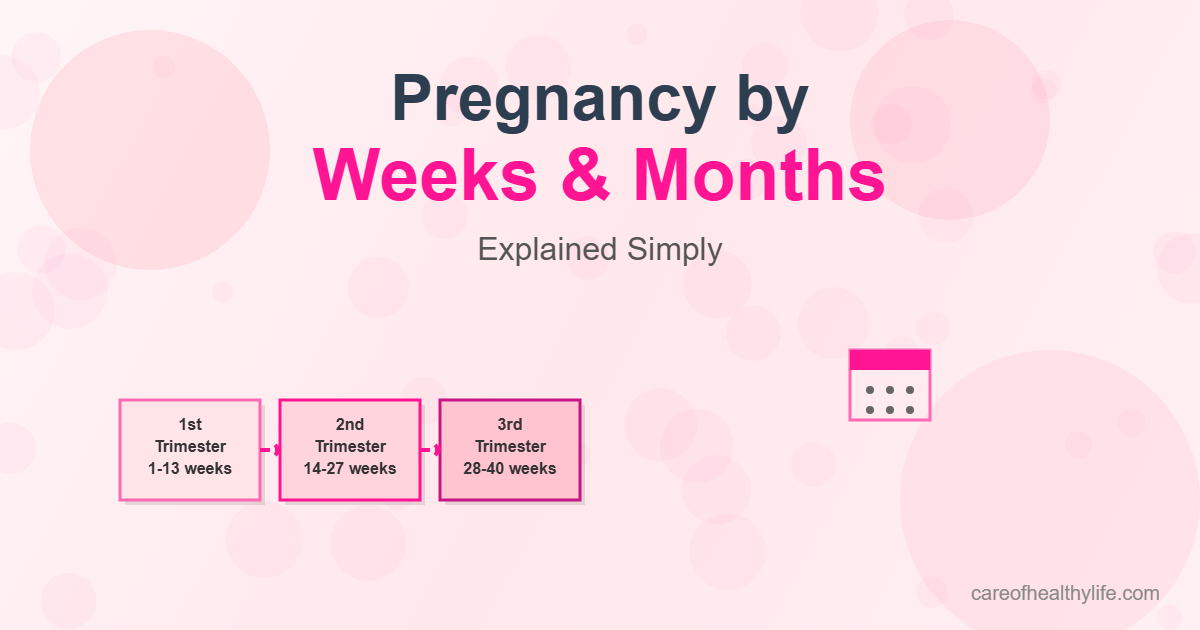
One of the most common questions I hear from expectant mothers is about pregnancy timelines. Understanding how your pregnancy progresses week by week and month by month helps you track your baby’s development and prepare for what’s ahead. Let me explain this in the simplest way possible.
What Does “Pregnancy by Weeks and Months” Mean?
When you discover you’re pregnant, you’ll notice something interesting: your doctor talks about weeks while friends and family ask which month you’re in. This dual tracking system can feel confusing at first, but both serve important purposes.
Healthcare providers prefer counting pregnancy in weeks because it offers precision for medical monitoring. Each week brings specific developmental milestones for your baby, and tracking by weeks allows doctors to schedule ultrasounds, tests, and checkups at exactly the right time. A full pregnancy lasts approximately 40 weeks from the first day of your last menstrual period. A curious mothers who want to know more about their due date pregnancy can calculate here with Georgian and Hijri calendar.
Months remain popular in everyday conversation simply because they’re easier to communicate. When someone asks how far along you are, saying “five months” feels more natural than “22 weeks.”
Here’s the alignment challenge: pregnancy months don’t match calendar months perfectly. Since most months have more than four weeks, the conversion isn’t straightforward. Generally, pregnancy spans about nine months and one week, or ten lunar months of 28 days each.
Pregnancy at a Glance (Weeks vs Months)
| Trimester | Weeks | Months | What’s Happening |
| First Trimester | 1-12 | 1-3 | Early pregnancy stage where key internal changes begin. |
| Second Trimester | 13-27 | 4-6 | A more stable phase with noticeable physical changes. |
| Third Trimester | 28-40 | 7-9 | Growth phase leading up to delivery. |
First Trimester Overview (Weeks 1-12)
Your baby develops at an extraordinary pace during this trimester. What begins as a cluster of cells quickly transforms into a recognizable human form.
Pregnancy by Months (Simple Breakdown)
Month 1 (Weeks 1-4)
Month one marks the very beginning of your pregnancy journey. Conception typically occurs around week two, though pregnancy dating starts from your last menstrual period.
Month 2 (Weeks 5-8)
Many women have their first detailed scan during the 8-week ultrasound, where you can see your baby’s tiny form moving on the screen. Your baby is growing rapidly, transforming from a tiny embryo into a recognizable fetus.
For comprehensive details about this stage, check out our guide on being 2 months pregnant.
Month 3 (Weeks 9-12)
This milestone is significant for another reason: the risk of miscarriage drops considerably after the first trimester. Many couples choose to share their pregnancy news publicly around this time.
Learn more in our 3 months pregnant guide. If you’ve had concerning test results, you might find our article on being 3 months pregnant but getting a negativepregnancy test helpful.
Months 4-6 (Second Trimester Overview)
The second trimester typically brings increased energy as early pregnancy symptoms fade. Your appetite often returns, and you may feel more like yourself again. Around 25 weeks pregnancy, your baby’s kicks may be strong enough for your partner to feel from the outside.
Months 7-9 (Third Trimester Overview)
The third trimester is characterized by rapid baby growth. Your little one gains most of their birth weight during these final months, and you’ll feel them running out of room as they grow larger and stronger.
Pregnancy by Weeks (Why Weeks Matter More Than Months)
While months provide a general framework, medical professionals track pregnancy in weeks for important reasons. Week-by-week tracking allows for precise medical monitoring and timing of important prenatal care.
Developmental milestones happen on a weekly basis. For example, certain ultrasounds must be performed within specific week ranges to be most effective. The 7-week ultrasound can detect the heartbeat, while the 20-week anatomy scan assesses your baby’s development in detail.
Your prenatal appointment schedule is also based on weeks. Early in pregnancy, you’ll typically see your doctor every four weeks. This increases to every two weeks around week 28, and weekly visits start around week 36.
Common Pregnancy Questions
When do you start showing in pregnancy?
Most first-time mothers begin showing between 12-16 weeks, though this varies significantly based on body type, fitness level, and whether you’ve been pregnant before. Second pregnancies often show earlier. Learn more about when you’ll start showing.
Can a pregnancy test be negative at 3 months?
While rare, it’s possible to get false negatives, especially with certain medical conditions or if testing incorrectly. If you have pregnancy symptoms but negative tests at 3 months, consult your healthcare provider.
Is it normal to have no symptoms early in pregnancy?
Yes, absolutely. Some fortunate women experience minimal or no early pregnancy symptoms. Every pregnancy is different. Lack of symptoms doesn’t indicate a problem, though you should still attend all scheduled prenatal appointments.
Pregnancy is medically tracked in weeks, but months are often used to help make each stage easier to understand.