
Nobody warned me about this part. When my wife was in her third trimester, I watched her spend 45 minutes arranging pillows just to find a position that did not make her back ache. Her hips burn, or her heartburn flare up the moment she lay down. She was exhausted by 8 PM, and yet somehow could not actually sleep until well past midnight.
If you are in your third trimester right now, you already know exactly what I mean. Your body is carrying an extraordinary load — physically, hormonally, emotionally. It is a combination of physical discomfort, hormonal changes, anxiety about the birth, and simply not knowing which adjustments actually move the needle. Furthermore, the popular advice of “just sleep on your left side” barely scratches the surface of what genuinely helps.
Why Third Trimester Sleep Is So Hard
Understanding WHY sleep becomes so difficult in the third trimester is the first step toward fixing it. In other words, you are not imagining it, you are not being dramatic, and you are not doing anything wrong. The difficulty is real and it is physiological.
your body is going through more simultaneous changes than at any other stage of pregnancy. As a result, sleep is affected from multiple directions at once.
Can’t sleep right now? Try these 3 things tonight for instant relief
The Only Three Sleep Positions That Matter in the Third Trimester
Getting your position right is not just about comfort. After 28 weeks, it directly affects your baby’s wellbeing. Therefore, understanding what the evidence actually says .
Left Side Sleeping ( The Preferred Position )
Sleeping on your left side is consistently recommended by obstetricians worldwide for good reason. In this position, your inferior vena cava (the large vein that returns blood to your heart) remains uncompressed, allowing optimal blood flow to both your heart and your placenta.
Furthermore, left-side sleeping supports kidney function more efficiently, which in turn helps reduce swelling in your feet, ankles, and hands. One of the most uncomfortable features of late pregnancy. Additionally, it keeps the weight of your uterus off your liver, which sits on your right side.
Dr. Khaliq’s Note: The “going-to-sleep position” is what the research specifically measures , not every position you find yourself in during the night. Starting on your side is what matters most.
Right Side Sleeping
Right-side sleeping is generally considered acceptable and significantly safer than sleeping on your back. While left-side sleeping is preferred for circulation reasons. The current evidence from Tommy’s (updated June 2026) indicates that either side is safe — and that rigidly forcing yourself to stay on your left side, causes unnecessary anxiety without clear additional benefit.
Most of the women’s naturally shift between sides throughout the night. This is completely normal and expected. Moreover, placing a pillow behind your back prevents you from rolling too far onto your back, while still allowing natural side-to-side movement during the night.
Note: Avoid sleeping on your right side if you have been diagnosed with placenta previa, or other specific conditions. Always follow your doctor’s individual guidance.
Back Sleeping After 28 Weeks (Avoid as Your Starting Position)

This is the position where the evidence is clearest and most important to understand. After 28 weeks, going to sleep on your back places the full weight of your growing uterus directly onto the inferior vena cava. The major blood vessel that carries blood back to your heart and onward to your placenta and baby.
Do Not Panic If You Wake Up on Your Back
This is one of the most common sources of unnecessary anxiety among pregnant women. If you wake up and find yourself on your back, simply turn onto your side and go back to sleep. As Tommy’s (June 2026) clearly states: “We don’t want you to become anxious about this. If your pregnancy is uncomplicated, your risk of stillbirth is low. Going to sleep on your side will make it even lower.”
The Pillow Setup That Actually Works
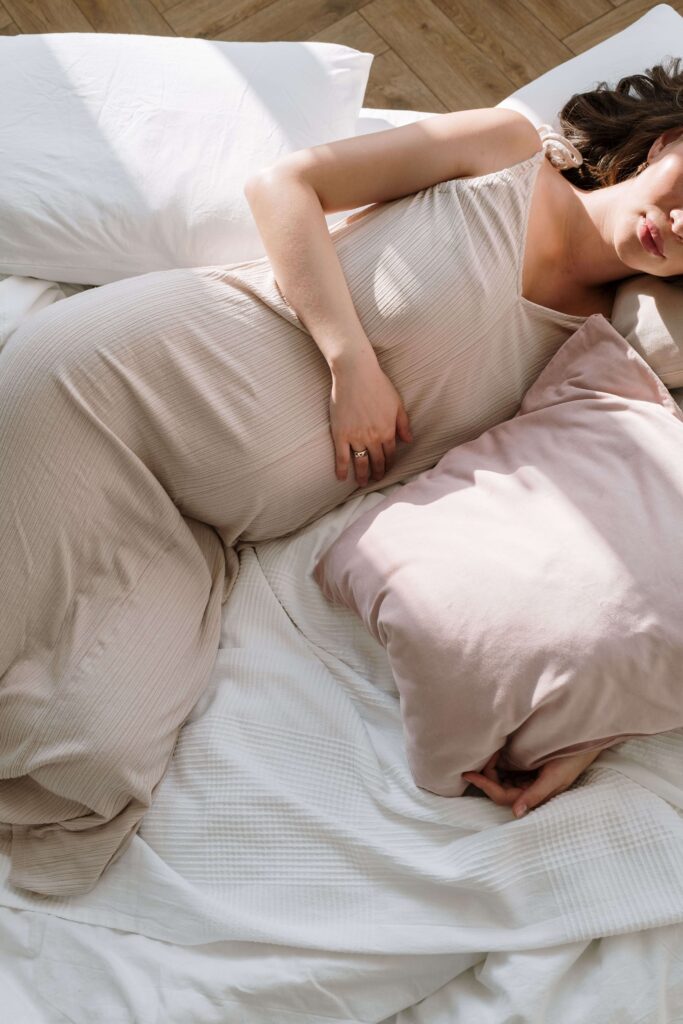
Pillows are not just comfort items in the third trimester, they are functional tools for body alignment. As your center of gravity shifts forward and the hormone loosens your ligaments and joints. your lower back, hips, and pelvis carry stress in new ways that regular pillow arrangements simply cannot address.
Additionally, the right pillow arrangement prevents you from rolling onto your back during the night , which means you sleep more consistently in the safer side position without even thinking about it.
The Four Pillow System ( What Goes Where and Why )
-
Between Your Knees
Place a firm pillow between your bent knees. This keeps your hips, pelvis, and spine in neutral alignment. Without this, your top knee drops forward, rotating your lower spine and causing the hip and lower back pain that wakes so many pregnant women at 3 AM.
-
Under Your Bump
A small, soft pillow tucked under your baby bump prevents the weight of your belly from pulling your lower spine into an uncomfortable downward curve while you lie on your side. Even a folded towel works for this purpose.
-
Behind Your Back
A firm pillow wedged against your back serves as a gentle barrier that prevents rolling onto your back during the night. Moreover, it gives you something to lean against slightly, which many women find relieves the feeling of being “stuck” on one side.
-
Head and Neck Support
Your head pillow needs to be thick enough to keep your neck level with your spine — not tilted up or down. If heartburn is a problem, add a second pillow to prop your shoulders and upper back up slightly (not just your head — that alone can worsen acid reflux).
Do You Need a Pregnancy Pillow?
Dedicated pregnancy pillows, the large U-shaped or C-shaped varieties . Combine all four functions above into one piece. They can be genuinely helpful, particularly if you find yourself constantly readjusting multiple pillows throughout the night. However, they are not essential, Strategic use of regular household pillows works just as effectively for most women.
Six Issues that discomfort your sleep in third trimester ( Tips to handle )
Here is a direct problem-solution approach covering the six most common issues, that specifically disrupt third trimester sleep.
| The Problem | Why It Happens | What Actually Helps |
|---|---|---|
| Heartburn at night | Your growing uterus pushes upward on your stomach. Additionally, the hormone progesterone relaxes the valve between your stomach and esophagus, allowing acid to rise more easily when horizontal. | Eat your last meal at least 3 hours before lying down. Furthermore, avoid spicy, fatty, and acidic foods after 5 PM. Prop your upper body (not just your head) with two pillows. Eating smaller, more frequent meals throughout the day also reduces the pressure that triggers reflux at night. |
| Frequent night urination | Your baby’s head presses directly on your bladder in the final weeks, dramatically reducing its capacity. Moreover, your kidneys process more fluid at night during pregnancy than at any other life stage. | Stop drinking fluids 90 minutes before bedtime — not earlier, as staying hydrated throughout the day is important for both you and your baby. Additionally, when you use the bathroom, lean forward slightly on the toilet to ensure your bladder empties completely, which reduces the frequency of return trips. |
| Leg cramps | Common from week 29 onwards, particularly at night. Thought to be linked to changes in circulation, calcium and magnesium levels, and the pressure your uterus places on leg nerves. | Stretch your calves gently before bed — straighten your leg, flex your foot upward, and hold for 20 seconds each side. Furthermore, staying active during the day with short walks significantly reduces nighttime cramp frequency. If a cramp strikes, flex your foot hard toward your shin (do not point your toes) and massage the muscle firmly. |
| Back and hip pain | The hormone relaxin loosens your ligaments in preparation for birth — but this also destabilises your hips and lower back, especially after hours in one position. | The knee pillow (pillow system above) is your most effective tool here. Additionally, a warm (not hot) bath or shower before bed relaxes the surrounding muscles. Prenatal yoga, even 10 minutes of gentle stretching during the day, also significantly reduces nighttime back pain by strengthening the supporting muscles around your pelvis. |
| Restless legs syndrome (RLS) | Affects roughly 10–34% of pregnant women, with symptoms typically worsening in the evening. Characterised by an uncomfortable crawling or tingling sensation that creates an uncontrollable urge to move the legs — making relaxation for sleep almost impossible. | Gentle leg movement before bed — walking, cycling your legs while lying down — provides temporary relief. Additionally, iron deficiency is a common contributing factor during pregnancy, so ask your doctor to check your iron levels if RLS is significantly affecting your sleep. Avoid caffeine completely, as it worsens RLS symptoms substantially. |
| Shortness of breath when lying down | Your expanding uterus pushes upward into your diaphragm, reducing the space available for your lungs to fully expand. As a result, many women feel breathless or uncomfortable when lying flat. | Propping your upper body to a 15–20 degree incline with extra pillows allows gravity to assist your diaphragm and creates more breathing room. Moreover, avoiding large meals within 3 hours of bedtime reduces the additional upward pressure on your diaphragm that a full stomach creates. |
Should You Nap During the Third Trimester?
Yes, but with boundaries. Short naps of 20–30 minutes during the day. Ideally before 3 PM, are genuinely restorative in the third trimester and do not significantly disrupt nighttime sleep for most women. In fact, research suggests that daytime rest during late pregnancy helps regulate the stress hormones that contribute to nighttime insomnia.
When to Contact Your Doctor
Most third trimester sleep difficulties are normal and manageable with the strategies above. However, contact your healthcare provider promptly if you notice any of the following:
- Loud snoring, gasping, or choking during sleep — this may indicate pregnancy-related sleep apnoea, which requires medical assessment
- Your baby’s movements feel significantly reduced or have stopped — contact your midwife or maternity unit immediately, not just during business hours
- Severe leg swelling, particularly if sudden or one-sided — this can occasionally indicate a blood clot and needs same-day assessment
- Headaches, visual changes, or upper abdominal pain alongside sleep disruption — these can be signs of pre-eclampsia requiring urgent evaluation
- RLS symptoms so severe they prevent sleep entirely — your iron levels and other factors may need investigation
Medical References & Sources
- Cronin RS, Li M, Thompson J, et al. “An individual participant data meta-analysis of maternal going-to-sleep position, interactions with fetal vulnerability, and the risk of late stillbirth.” EClinicalMedicine. 2019;10:49–57. View on PubMed →
- Kember AJ, et al. “Sleeping posture in pregnancy.” CMAJ. 2025;197(23):E645. View on PMC →
- Anderson NH, et al. “Association of supine going-to-sleep position in late pregnancy with reduced birth weight.” JAMA Network Open. 2019;2(10):e1912614. View on PubMed →
- Tommy’s. “Sleep position in pregnancy Q&A.” Reviewed June 2026. Read on Tommy’s →
- Sleep Foundation. “Sleeping During Third Trimester.” Updated July 2025. Read on Sleep Foundation →
- National Library of Medicine / UpToDate. “Insomnia and sleep disturbances in pregnancy.” View on NIH →